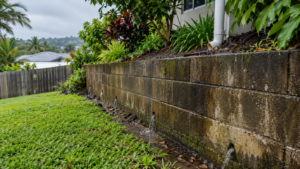

The house photographs well. Deck, new bathroom, a bit of a view. Then you wander down the side path and there’s a block wall holding back half the yard, with a lean you only spot once you crouch and sight along the top.
Storm season officially starts on 1 September, so it’s already underway. Suncorp and the Queensland SES have urged Queenslanders to inspect retaining walls and clean out gutters before the weather turns. That advice is written for owners. If you’re buying, it’s worth even more, because anything you find can still go into the price.
We’re QBCC licensed builders, and plenty of our pre-purchase inspections are on sloping blocks, from the hills around Brisbane to the Sunshine Coast hinterland, Gympie and Toowoomba. Here’s what we look at, and what you can check yourself at the next open home.
What does a retaining wall look like before it fails?
Walls rarely let go overnight. They send small warnings that most people walk straight past.
Lean is the obvious one. Stand at one end and sight along the top edge. A straight wall reads as a straight line, while one that’s been pushed from behind bellies out in the middle or tilts forward as a whole. Even a slight lean counts, because the soil behind keeps pressing and never eases off.
Cracks come next. Stepped cracks that follow the mortar joints in a block wall suggest the footing has moved. A horizontal crack around mid-height often points to pressure from behind. On a timber sleeper wall, look for boards bowed between the posts and posts that have tilted.
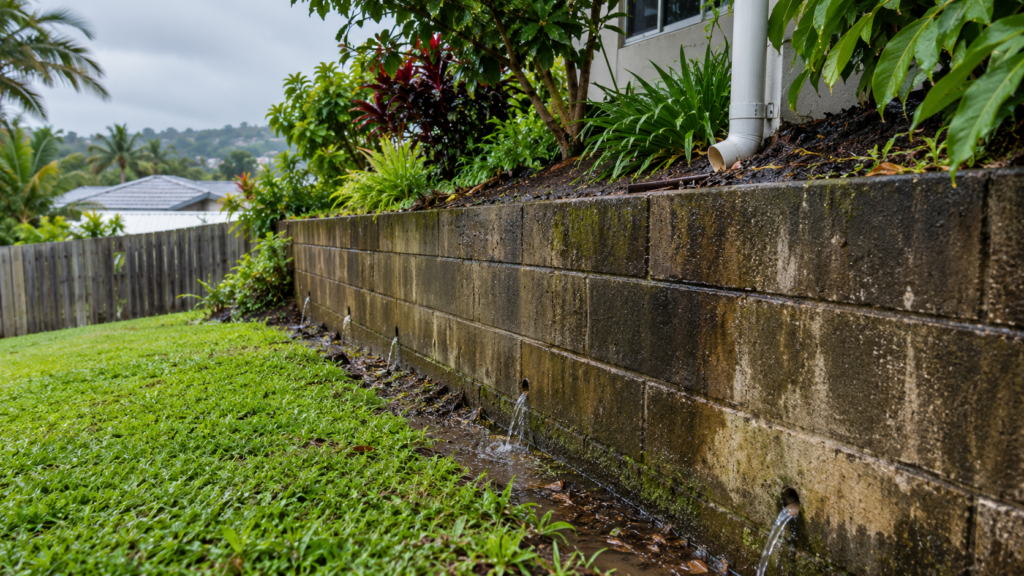
Then look at the ground either side. Settlement or sinkholes behind a wall, horizontal cracks and white staining can all point to water pressure building up. Cracks in the lawn running parallel to the wall, or paving above it that’s started to sink, tell the same story. Below the wall, soil washing through the face leaves staining and can clog the weep holes, so muddy streaks or a fan of silt across the base are worth noting.
One more check: what’s sitting above the wall. A driveway, shed, pool or a row of parked cars adds load the wall may never have been designed to carry.
Why do weep holes matter?
Water is what kills most retaining walls. Dry soil holds itself up reasonably well. Saturated soil is heavier and pushes harder, and a wall built for one won’t cope with the other. Blocked weep holes and drain pipes are among the most commonly cited causes of wall distress, because water builds up behind the wall and adds pressure it may not have been designed for.
Weep holes are the small openings low in the face of a block or masonry wall. They work with the gravel and slotted pipe behind them as a pressure relief system. Check that the wall has some, that they sit near the base at regular spacing, and that they aren’t clogged with dirt, mortar droppings, roots or garden mulch. After rain, a working weep hole should show some seepage, and one that stays dry may be clogged.
A caveat, because we’d rather be straight with you: we can’t see inside a wall. Plenty of walls drain through a pipe behind them that runs out to a stormwater connection or a spoon drain, and you won’t spot that from the front. Councils say most retaining walls need a subsoil drainage system behind them to relieve water pressure. That’s why the paperwork questions further down matter.
Where does storm water go on a sloping block?
The wall is half the story. The other half is every litre that lands on your roof and the ground above you, and on a slope all of it is heading downhill. We trace the path and look for whatever’s in the way. Often that’s the house.
Downpipes come first. Do they connect to an underground line, or just dump at the footing? We look for cracked joints, disconnected elbows and outlets that discharge against a wall. Then the stormwater pits and grates. A pit choked with leaf litter or silt can’t take a storm flow, and the overflow goes wherever the ground is lowest.
Gutters matter too. Backed-up gutters can send water into the home, and on a slope the overflow tends to run straight down the wall line below.
Then the grading. Ground should fall away from the building. We look for soil built up against external walls, raised garden beds, paving that tilts back toward the house and lawn that dishes near the slab. Ponding that hangs around against a wall after rain is the red flag, because water sitting against a slab edge or footing has nowhere good to go.
Finally, what’s arriving from above. Council guidance lists sub-drainage and spoon drainage at the top and base of a wall as part of the retaining wall system. If runoff from the uphill neighbour arrives with no drain to catch it, that load lands on your wall. Where the wall sits on or near the boundary, councils describe upkeep between neighbours as a civil matter, so find out whose wall it is before you buy it.
How do drainage problems lead to subfloor moisture and termites?
Water that can’t get away finds its own way in. On a slab house it ponds at the edge, soaks the ground and tracks into bottom plates and wall linings. On a highset or lowset house it runs under the floor, and you get damp soil, wet piers, condensation and timber that never dries out.
Termites follow moisture. Queensland Government guidance notes that termites working inside a building usually stay in contact with the soil for moisture, and it advises removing the conditions that favour them. A leaking wall or a blocked downpipe soaking the ground beside a footing is exactly that kind of condition. We’ve covered the conducive conditions for timber pests and the causes of water damage around the home in earlier posts.
This is where one inspector for both reports pays off. The person who finds the wet subfloor is the same person checking that subfloor for termite activity, using thermal and moisture detection equipment. Nothing falls between two reports.
Looking at a sloping block right now? Book a pre-purchase building and pest inspection and we’ll walk the wall, the downpipes and the subfloor with you on site.
Do I need a retaining wall inspection before buying?
If the block slopes and there’s a wall on it, yes. Look at it before you sign, or before the inspection date runs out if your contract has a building and pest condition. A pre-purchase inspection reports on the condition we can see, including the drainage and conducive conditions around the house, and flags anything that needs a specialist.
We’re builders, not structural engineers. If we see movement in a wall, we’ll say so and recommend an engineer, because that’s the report that tells you what a repair or rebuild will take. If you only want the structure covered, we also offer building inspection only. On a slope we’d usually suggest adding pest, since moisture and termites travel together.
Councils say most retaining walls need building approval. The rules vary between councils, so the paperwork is worth chasing.
What should you ask the seller about the retaining wall?
Put these to the agent and ask for the answers in writing:
- Was the wall approved, and is there an engineer’s design or a certificate from the builder?
- Who built it, and when?
- Is it entirely on this property, or does it sit on the boundary?
- Has it moved, been repaired or had drainage work done? Are there receipts?
- Where do the downpipes discharge, and has water ever entered the yard, garage or subfloor in heavy rain?
- Has anything been added uphill since, such as a driveway, shed or pool?
- When were the gutters, pits and weep holes last cleared?
- Has there been any termite activity or treatment, and where?
Look at the wall yourself too. A freshly painted or rendered face, or a new garden bed planted hard against the base, deserves a second look.
What if the seller won’t negotiate?
It happens, and it isn’t the end of the road. Start with what your contract says. In the standard REIQ contract, if the inspection date isn’t filled in, the contract isn’t subject to the building and pest condition. When it is, the contract is conditional on you getting reports on terms satisfactory to you, and you can terminate if, acting reasonably, a report is unsatisfactory. If you miss the 5 pm notice deadline on the inspection date, the seller can terminate. Our post on your rights as a buyer in Queensland covers the basics.
Then work through it in order.
- Put a number on the problem. Get a written quote from a licensed contractor, plumber or engineer. A figure is much harder to wave away than a worry.
- Ask for something other than a price cut. Common alternatives are having the seller rectify the issue or provide a credit at settlement.
- Decide what’s non-negotiable. A wall that’s actively moving with water behind it, or termite activity tied to a wet subfloor, is a different conversation from a blocked pit and a loose downpipe elbow.
- Be ready to walk. If the seller still won’t move, you can terminate, or waive the condition and buy knowing the issues will still be there when you take possession. A minor defect usually won’t justify terminating, so talk to your conveyancer or solicitor before the date, not after. We’re not lawyers, and this isn’t legal advice.
Buying at auction? The cooling-off period doesn’t apply to auctions, so the inspection has to happen before you bid.
What can you do before storm season?
If you’ve just bought, or you’re about to, a few jobs take an hour and cost nothing.
Clear the gutters, downpipes and drains of leaves and debris, and inspect the retaining walls, as Suncorp advises. Rake mulch and soil back from the weep holes and away from the slab edge. Tip a bucket of water into the pit nearest the wall and watch how fast it drains.
Then walk the block during the first heavy rain with a torch. Look at where water runs, where it ponds and whether the weep holes are weeping. Stretch a string line along the top of the wall and photograph the gap from the same spot each season. If that gap grows, call an engineer.
Buying on a slope this season? Book a pre-purchase building and pest inspection with Informed Building Inspections. One inspector covers building and pest, you get a walk-through on site, and your report arrives within 24 hours, with same day available. Get a free quote or call 1300 246 367.
Frequently asked questions
Can a building inspector tell me if a retaining wall is safe? We report the condition we can see, including lean, cracking, drainage and signs of water or soil movement. We’re builders, not structural engineers, so if there’s movement or doubt, we’ll recommend an engineer assess it before you commit.
Should water come out of retaining wall weep holes? After heavy rain, a working weep hole usually shows some seepage. One that stays dry while the soil around it is soaked may be blocked. Some walls drain through a pipe behind the wall instead, so a dry hole isn’t proof on its own.
Do retaining walls need council approval in Queensland? Councils advise that most retaining walls need building approval, and drainage is part of that. Rules vary, so check with the local council or a private building certifier about a specific wall.
Can I back out of a contract if the retaining wall is in bad shape? If your contract includes the building and pest condition, you can terminate if you act reasonably and give notice by the inspection date. Minor defects usually don’t qualify, so speak to a conveyancer or solicitor before the deadline.